
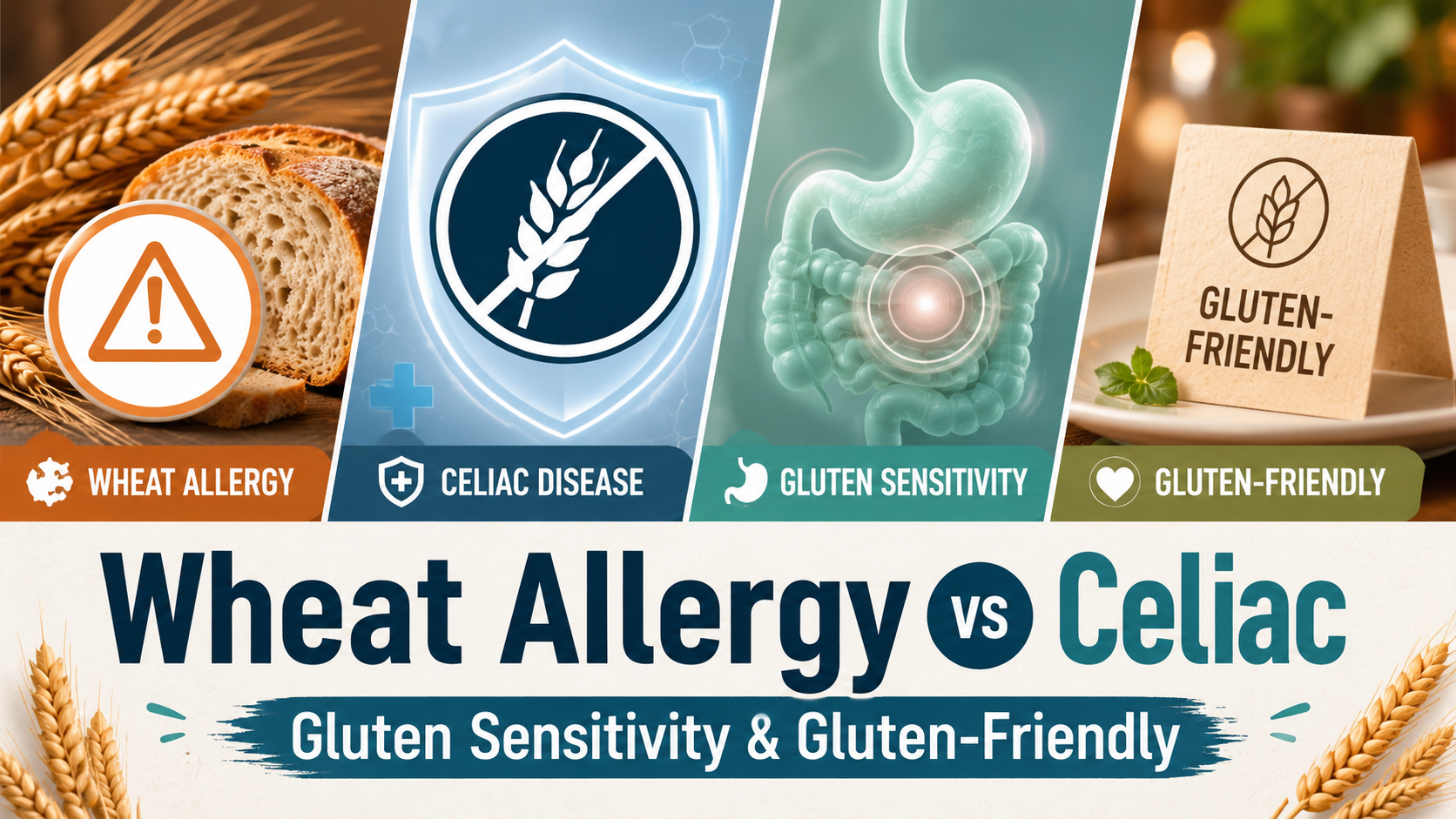
Gluten has become one of the most confusing words in dining.
A diner says they have a “gluten allergy.”
A menu shows gluten-free.
Another says gluten-friendly.
A product says wheat-free.
Those phrases may sound like different ways of describing the same problem.
They are not.
Wheat allergy, celiac disease, and non-celiac gluten/wheat sensitivity are different conditions. Wheat-free and gluten-free do not mean the same thing. And a restaurant calling something gluten-friendly does not tell a diner whether it is appropriate for celiac disease.
The distinction matters because each term answers a different question:
What needs to be avoided?
Why does it need to be avoided?
And what does the diner need to know about preparation?
Getting those answers right gives diners better information and helps restaurants describe what they can actually accommodate.
The Short Answer
| Term | What it means |
|---|---|
| Wheat allergy | An allergic reaction to proteins in wheat |
| Celiac disease | An immune-mediated disease triggered by gluten |
| Non-celiac gluten/wheat sensitivity | Symptoms associated with gluten- or wheat-containing foods without celiac disease or wheat allergy |
| Wheat-free | Does not contain wheat, but may still contain other gluten-containing grains |
| Gluten-free | For FDA-regulated packaged foods in the U.S., a defined labeling claim that includes a limit of less than 20 ppm gluten |
| Gluten-friendly | A restaurant or preference-style term that does not by itself establish that an item is appropriate for someone with celiac disease |
The most important distinction is simple:
Wheat-free and gluten-free are not the same thing.
Wheat is only one source of gluten, so removing wheat does not necessarily make a food gluten-free.
That difference becomes especially important when looking at wheat allergy and celiac disease.
The Problem With the Term “Gluten Allergy”
A gluten allergy does not exist as a recognized medical condition.
The American College of Allergy, Asthma & Immunology explains that there is no such thing as a gluten allergy and distinguishes wheat allergy from celiac disease and other gluten-related conditions.
But the term “gluten allergy” is commonly used by diners and is also sometimes used by restaurants.
Usually, it is understood to mean that someone needs to avoid gluten. The problem is that the term does not indicate why they are avoiding it or the level of caution needed around ingredients, preparation, and cross-contact.
Those differences become clearer when looking at the conditions individually.
Celiac Disease: The Issue Is Gluten
Celiac disease is an immune-mediated disease triggered by gluten rather than an allergy. The NIDDK describes it as a chronic digestive and immune disorder in which eating gluten damages the small intestine.
Someone with celiac disease needs to avoid gluten from wheat, barley, rye, triticale, and ingredients derived from these grains, including malt.
Oats require additional attention. Although oats themselves are different from wheat, barley, and rye, cross-contact with gluten-containing grains can occur during growing, processing, transportation, and manufacturing. The NIDDK therefore notes that people with celiac disease should make sure the oats they eat are gluten-free.
Wheat Allergy: The Issue Is Wheat
A wheat allergy is an allergic reaction to proteins in wheat.
Someone with a wheat allergy needs to avoid wheat and wheat-derived ingredients. That includes obvious foods such as bread, pasta, couscous, baked goods, breading, and batter, as well as less obvious sources such as some sauces, soy sauces, thickeners, and processed foods.
The restriction is specific to wheat. Rye and barley can be consumed unless another allergy, sensitivity, or condition requires avoiding them.
A wheat allergy is an allergic reaction to proteins in wheat.
Someone with a wheat allergy needs to avoid wheat and wheat-derived ingredients. That includes obvious foods such as bread, pasta, couscous, baked goods, breading, and batter, as well as less obvious sources such as some sauces, soy sauces, thickeners, and processed foods.
Unlike celiac disease, the concern is specifically wheat. Rye and barley can be consumed unless another allergy, sensitivity, or condition requires avoiding them.
Health Canada distinguishes a wheat-free diet for wheat allergy from the strict gluten-free diet required for celiac disease.
Gluten Sensitivity: Real Symptoms, Less Certain Triggers
Non-celiac gluten/wheat sensitivity is another category.
It is not celiac disease.
It is not a wheat allergy.
People with non-celiac gluten/wheat sensitivity experience symptoms associated with eating gluten- or wheat-containing foods without having celiac disease or wheat allergy.
The NIDDK notes that gluten sensitivity does not cause the same damage to the small intestine as celiac disease.
One reason this category can be confusing is that the trigger is not always as straightforward as the name suggests.
A 2023 study of 2,133 U.S. adults found that 5.1% self-reported intolerance to at least one of wheat, barley, rye, flour, or pasta.
The pattern inside that number is especially interesting.
Wheat was reported much more frequently than barley or rye. Among respondents reporting gluten-related intolerance, wheat accounted for much of the self-reported intolerance, while relatively few respondents reported intolerance across all of the gluten-containing foods examined.
That does not mean 5.1% of Americans have clinically established non-celiac gluten sensitivity.
It means self-reported intolerance to foods associated with gluten is not uncommon, and that wheat appears to account for much of the reported intolerance in that survey.
This helps explain why the term non-celiac gluten/wheat sensitivity is increasingly useful.
For some people, gluten may be involved.
For others, wheat or another component of wheat-containing foods may contribute to symptoms.
For restaurants, the practical lesson is that people avoiding gluten do not necessarily all have the same condition or the same needs.
Wheat-Free, Gluten-Free, and Gluten-Friendly Are Not the Same
Once the medical conditions are separated, the menu terminology becomes easier to understand.
Wheat-Free
Wheat-free means wheat is not present.
It does not automatically mean the food is free from barley, rye, malt, or every other source of gluten.
A wheat-free item may therefore work for someone avoiding wheat while still being inappropriate for someone with celiac disease.
Gluten-Free
In the United States, “gluten-free” has a defined meaning for FDA-regulated packaged foods.
The FDA treats “gluten-free,” “no gluten,” “free of gluten,” and “without gluten” as equivalent claims.
Foods carrying those claims must meet the FDA requirements, including containing less than 20 parts per million of gluten.
The rule also addresses ingredients derived from wheat, barley, rye, and their crossbreeds.
That makes gluten-free more than a general marketing phrase when it appears on an FDA-regulated packaged food.
Restaurants are different from packaged-food manufacturers.
The FDA’s packaged-food gluten-free labeling rule does not apply to restaurants in exactly the same way, but the agency recommends that restaurants using a “gluten-free” claim make that claim consistent with the federal definition.
That means “gluten-free” is meaningful terminology.
But in a restaurant, the words alone still may not tell a diner everything about how the food is prepared.
Gluten-Friendly
“Gluten-friendly” is different.
It is commonly used by restaurants to describe an option intended for people avoiding gluten.
But gluten-friendly is not another version of the FDA gluten-free standard.
A restaurant may use the term when an item is made without gluten-containing ingredients but prepared in a kitchen where gluten is also present.
That can still be useful information.
But it should be treated as a description of what the restaurant offers, not as a guarantee that the food meets the needs of every person avoiding gluten.
For someone avoiding gluten as a preference or because of personal tolerance, that may be enough.
For someone with celiac disease, it may not be.
Ingredients Are Only Half of the Restaurant Question
Knowing what is in a dish is the first step.
Knowing how it is prepared is the second.
This is where restaurant dining differs from simply reading the label on a packaged food.
A dish can begin with gluten-free ingredients and still come into contact with gluten during preparation.
Examples can include:
- a shared fryer used for breaded foods
- pasta cooked in water also used for wheat pasta
- pizza prepared on a flour-covered surface
- food cooked on shared equipment with gluten residue
- utensils, cutting boards, or prep surfaces also used for gluten-containing foods
The existence of shared equipment does not by itself tell a diner exactly what exposure will occur.
What matters is the restaurant’s actual preparation process.
That is why a useful restaurant conversation goes beyond:
Is this gluten-free?
It asks:
What ingredients are used, and how is it prepared?
A restaurant that can answer both questions gives diners much more useful information than one relying on a label alone.
Gluten-Free Alternatives That Actually Expand the Menu
Avoiding gluten does not have to mean removing bread or pasta and leaving an empty space on the plate.
There are many naturally gluten-free foods and ingredients that can form the basis of complete dishes.
Common options include:
- rice
- corn
- potatoes
- quinoa
- buckwheat
- millet
- sorghum
- teff
- amaranth
- tapioca
- cassava
- beans and legumes
- chickpea flour
- lentil pasta
- almond flour
- coconut flour
- certified gluten-free oats
The Celiac Disease Foundation lists many naturally gluten-free grains, starches, legumes, seeds, and flours that can be used as alternatives to traditional wheat-based foods.
These ingredients can replace gluten-containing foods in practical ways.
Pasta can be made from rice, corn, lentils, chickpeas, or quinoa.
Corn tortillas can replace wheat flour tortillas.
Rice noodles, sweet potato noodles, and other gluten-free noodles can replace wheat noodles.
Breading can use cornmeal, rice flour, potato starch, or gluten-free breadcrumbs.
Pizza crusts and baked goods can use combinations of rice flour, tapioca starch, potato starch, sorghum flour, almond flour, and other gluten-free ingredients.
Bowls can use rice, quinoa, potatoes, corn, beans, vegetables, and other naturally gluten-free foods without needing a wheat-based component at all.
There are also ingredients whose names can be misleading.
Buckwheat is naturally gluten-free despite having “wheat” in its name.
But a product made with buckwheat is not necessarily gluten-free if wheat flour is also added.
Oats are another example.
Oats can be part of a gluten-free diet, but people with celiac disease should choose oats that meet gluten-free requirements because cross-contact with wheat, barley, and rye is common.
The alternative itself is therefore only part of the answer.
The ingredient list and preparation still have to match the diner’s needs.
Why Simpa Separates Wheat Allergy, Gluten, and Gluten-Friendly
Simpa separates these categories because they communicate different dining needs.
Wheat Allergy is for diners who need to avoid wheat as an allergen.
Gluten is for diners avoiding gluten because of celiac disease, gluten sensitivity, or another gluten-related dietary need.
Gluten-friendly describes a broader restriction or preference around avoiding gluten without automatically representing a celiac-safe preparation standard.
There is overlap between these groups.
But overlap does not make them interchangeable.
A wheat-allergic diner may not need to avoid barley or rye.
A diner with celiac disease does need to avoid gluten from those grains.
A diner with non-celiac gluten/wheat sensitivity may have needs that depend on what produces their symptoms.
And someone choosing gluten-friendly foods for another dietary reason may not require the same preparation practices as someone with celiac disease.
Separating the categories gives restaurants a clearer way to describe what they can actually accommodate.
It also gives diners better information before deciding where or what to eat.
What Diners Should Look For
Restaurant labels are useful, but they do not always tell the whole story.
A gluten-friendly item may be intended for people avoiding gluten without necessarily being appropriate for someone with celiac disease. A gluten-free label is more specific, but preparation still matters when cross-contact is a concern.
For diners who need stricter avoidance, the most useful information is not just the label itself, but what ingredients are used and how the food is prepared.
Final Thought
Wheat allergy, celiac disease, and gluten sensitivity all intersect with gluten-free dining.
But they do not describe the same condition.
And wheat-free, gluten-free, and gluten-friendly do not communicate the same thing.
Once those distinctions are clear, the rest becomes much easier.
Restaurants can describe their food more accurately.
Diners can ask better questions.
And gluten-free alternatives can be evaluated based on both their ingredients and the way they are prepared.
The goal should not be to make diners decode vague terminology at the table.
It should be to give them enough information to understand what a restaurant offers and decide whether it matches what they need.
Clearer language means less guessing.
And when food restrictions affect someone’s health, less guessing matters.
Sources and Notes
- The FDA identifies wheat as one of the major food allergens in the United States: https://www.fda.gov/food/nutrition-food-labeling-and-critical-foods/food-allergies
- The FDA explains its gluten-free labeling requirements, including the limit of less than 20 parts per million of gluten: https://www.fda.gov/consumers/consumer-updates/gluten-free-means-what-it-says
- The FDA explains gluten-free labeling terminology and how the rule applies to packaged foods: https://www.fda.gov/food/nutrition-education-resources-materials/gluten-and-food-labeling
- The American College of Allergy, Asthma & Immunology explains that there is no such thing as a gluten allergy and distinguishes wheat allergy from celiac disease: https://acaai.org/allergies/allergic-conditions/food/wheat-gluten/
- The NIDDK explains that celiac disease is different from wheat allergy and that gluten sensitivity does not damage the small intestine in the way celiac disease does: https://www.niddk.nih.gov/health-information/digestive-diseases/celiac-disease/definition-facts
- The NIDDK explains gluten-free eating for celiac disease and notes the importance of gluten-free oats because cross-contact with gluten-containing grains is common: https://www.niddk.nih.gov/health-information/digestive-diseases/celiac-disease/eating-diet-nutrition
- The Celiac Disease Foundation defines gluten and explains its sources: https://celiac.org/what-is-gluten/
- The Celiac Disease Foundation lists naturally gluten-free foods, grains, starches, and flours: https://celiac.org/gluten-free-living/gluten-free-foods/
- The Celiac Disease Foundation explains non-celiac gluten/wheat sensitivity: https://celiac.org/about-celiac-disease/related-conditions/non-celiac-wheat-gluten-sensitivity/
- Health Canada distinguishes celiac disease from wheat allergy and explains that wheat allergy requires avoiding wheat while rye and barley may still be consumed unless another condition or sensitivity is present: https://www.canada.ca/en/health-canada/services/food-nutrition/reports-publications/food-safety/gluten-pamphlet.html
- Jansson-Knodell CL, et al. “Self-Reported Gluten Intolerance Is Prevalent, but Not All Gluten-Containing Foods Are Equal.” Dig Dis Sci. 2023. https://pubmed.ncbi.nlm.nih.gov/36662341/