
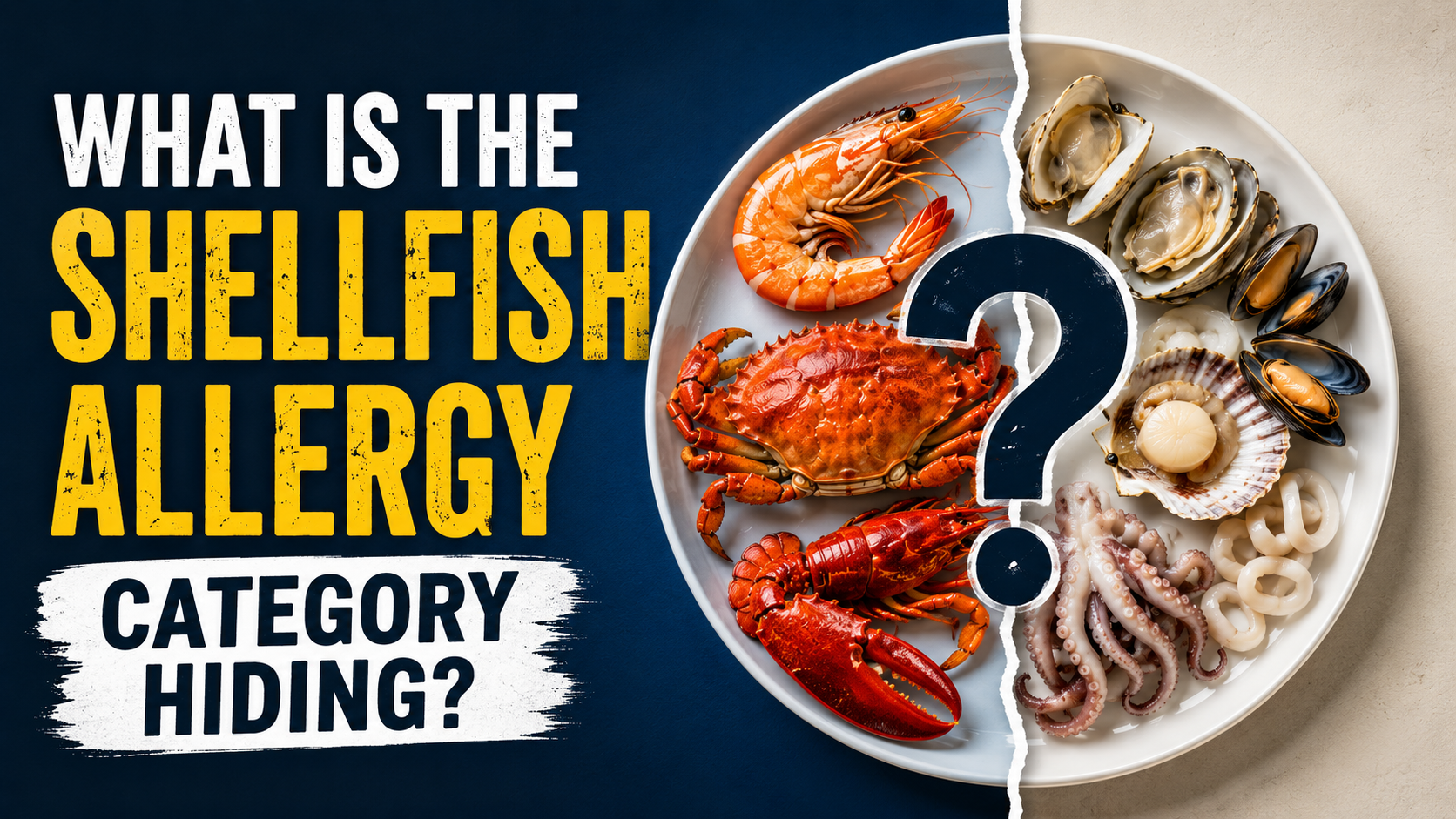
Shellfish is the most commonly reported convincing food allergy among adults in the United States.
A large national study estimated that 2.9% of US adults have a convincing shellfish allergy, making it more common in adults than allergies to milk, peanuts, tree nuts, or finfish.
As we discussed in our article about the scale of shellfish allergy, this is not a niche restriction. It affects millions of adults and can cause severe reactions.
That makes an overlooked problem with the category especially important.
A menu displays a shellfish symbol. A restaurant app offers a shellfish option. A diner tells a server, “I have a shellfish allergy.”
Everyone appears to understand the restriction.
But do they?
Does shellfish mean shrimp and crab? Does it include clams and oysters? What about scallops, squid, or octopus? Does reacting to one of these foods mean that every other food in the category is unsafe?
The question at the center of this confusion is simple:
Can you be allergic to shrimp but not clams?
Source: Prevalence and Severity of Food Allergies Among US Adults, National Institutes of Health
Can You Be Allergic to Shrimp but Not Clams?
Yes.
A person can have a confirmed shrimp allergy while tolerating clams, oysters, mussels, or scallops. The reverse is also possible. Someone can react to a mollusk without being allergic to shrimp, crab, or lobster.
The research helps explain why.
A clinical review reported that approximately 75% of people with a crustacean allergy react to more than one type of crustacean.
Clinical cross-reactivity between crustaceans and mollusks, however, is estimated at only 10% to 20%.
Those figures do not tell an individual person what they can safely eat. Studies use different diagnostic methods, and a positive allergy test does not always predict a reaction when the food is eaten.
The numbers do show that the shellfish category contains two very different patterns. Reactions frequently overlap within the crustacean group, while overlap across the crustacean and mollusk divide appears much less common.
Sources:
- IgE-Mediated Shellfish Allergy in Children, National Institutes of Health
- Common Food Allergens and Cross-Reactivity, National Institutes of Health
Crustaceans and Mollusks Are Not One Biological Family
Shellfish is a culinary umbrella term rather than a single biological classification.
For allergy purposes, it mainly combines two groups.
Crustaceans
Crustaceans include:
- shrimp
- prawns
- crab
- lobster
- crawfish
They have segmented bodies, jointed legs, and hard external skeletons.
Mollusks
Mollusks include:
- clams
- oysters
- mussels
- scallops
- squid
- octopus
- snails
Some mollusks live inside visible shells. Others, including squid and octopus, have no external shell at all.
Both groups can contain allergenic proteins such as tropomyosin, a heat-stable protein found in muscle tissue. That shared protein helps explain why cross-reactivity between the groups is possible.
It does not make the groups medically interchangeable.
Crustaceans tend to contain closely related versions of several allergens. An immune system that recognizes a protein in shrimp may therefore recognize a similar protein in crab or lobster.
Mollusks can share some of those allergens, but the degree of similarity and the clinical response vary. Someone may show sensitization to both groups on an allergy test without developing symptoms when both are eaten.
That distinction matters because sensitization is not the same as a confirmed clinical allergy.
Why Allergy Testing Does Not Give a Simple Answer
A positive skin-prick test or blood test means the immune system recognizes something in the tested food.
It does not always mean that eating the food will cause a reaction.
This is particularly important when evaluating crustacean and mollusk allergies because related proteins can produce positive results across different species. Cross-reactivity with environmental allergens such as dust mites can complicate testing further.
An allergist may need to consider:
- the person’s reaction history
- skin-prick testing
- allergen-specific blood testing
- component-resolved testing
- a medically supervised oral food challenge
Research involving shrimp-allergic patients found that current diagnostic methods cannot reliably predict whether someone will react clinically to mollusks. The researchers also concluded that mollusks should not automatically be removed from every shrimp-allergic patient’s diet without an individualized assessment.
That is not an invitation to test clams or oysters at home.
Someone with a serious food allergy should establish their boundaries with a qualified healthcare professional. Population-level research can identify patterns, but it cannot determine what is safe for one person.
Source: Mollusk Allergy in Shrimp-Allergic Patients, National Institutes of Health
The Allergy Category Should Be Split
The current category obscures information that matters.
Grouping shrimp, crab, lobster, and crawfish together can be useful because reactions often extend across crustacean species.
Automatically extending the same restriction to clams, oysters, mussels, scallops, squid, and octopus is less defensible. Those foods belong to another biological group, and an allergy to a crustacean does not automatically establish an allergy to a mollusk.
For medical assessment and allergy communication, crustaceans and mollusks should be treated as separate families.
Yet most menus, restaurant systems, food databases, and dining apps still present one broad shellfish option.
The reason is probably not that the biological difference is unknown.
The problem is language.
Why the Category Has Not Been Split
The scientifically accurate names already exist:
Crustaceans
and
Mollusks
Those words work well in medicine and biology. They work less reliably during a busy restaurant interaction.
Imagine a diner saying:
I have an anaphylactic allergy to crustaceans, but my allergist has confirmed that I can eat certain mollusks.
The statement is precise, but the server may not immediately know which ingredients belong to each group.
Are scallops crustaceans or mollusks?
Where does squid belong?
Does oyster sauce count?
The diner may end up translating the scientific terminology into a list of familiar foods anyway.
“Shellfish,” by comparison, is short and widely recognized. It quickly communicates that a serious seafood-related restriction exists, even when it fails to describe that restriction accurately.
That creates a vocabulary trap.
The familiar word is too broad for personalized allergy safety. The accurate words are too academic for effortless mainstream use.
The shellfish category survives because it is easy to say, not because it is medically complete.
What the Shellfish Label Does at Restaurants
When a diner says, “I have a shellfish allergy,” the restaurant still does not know whether the person needs to avoid:
- shrimp only
- every crustacean
- one or more mollusks
- foods from both groups
- all shellfish because their individual tolerance has not been assessed
Faced with that uncertainty, restaurant staff may take the broadest possible precaution.
That response can be appropriate. Shrimp, crab, clams, fish, and other seafood may share fryers, grills, pans, utensils, sauces, stocks, storage areas, and preparation surfaces. Even when a particular ingredient is medically safe for someone, the restaurant may be unable to control cross-contact with another ingredient that is not.
The umbrella term can still create problems in both directions.
A diner with a crustacean allergy who has been medically cleared to eat certain mollusks may be excluded from suitable dishes because the restaurant treats every shellfish as the same allergen.
Meanwhile, a diner with a severe clam or oyster allergy may assume that a restaurant’s shellfish procedures fully cover mollusks when staff are primarily thinking about shrimp, crab, and lobster.
The same phrase is being used to communicate different restrictions.
Ingredient Names Are Easier to Act On
Restaurant workers should not need a marine biology lesson to understand an allergy.
Specific ingredient names are easier to connect to a recipe, storage container, sauce, or preparation surface.
Instead of saying only:
I have a shellfish allergy.
A diner with a diagnosed crustacean allergy might say:
I have a severe allergy to shrimp, crab, lobster, and crawfish. Please check whether this dish or its preparation area comes into contact with any of them.
Someone with a mollusk allergy might say:
I am allergic to clams, oysters, mussels, and scallops. Please check the sauce, broth, seasoning, and shared equipment.
Someone who has been medically cleared to eat a particular food can explain that distinction while still asking the restaurant to evaluate cross-contact.
Specific language does not guarantee that the kitchen can safely accommodate the diner.
It gives the restaurant a clearer restriction to assess.
US Food Labels Already Treat the Groups Differently
The shellfish umbrella also hides an important difference in United States packaged-food labeling.
Federal law recognizes Crustacean shellfish as one of the nine major food allergens.
When an FDA-regulated packaged food contains a crustacean ingredient, the specific species must be declared. A manufacturer cannot satisfy the requirement by listing only “Crustacean shellfish.”
The label must identify the species, such as:
- shrimp
- crab
- lobster
Mollusks are not included in the same federal major-allergen category.
This does not mean a manufacturer can freely omit an intentionally added clam, oyster, mussel, or scallop ingredient. Ingredients generally still need to appear in the ingredient list under their common or usual names.
The difference is prominence.
A crustacean must receive major-allergen treatment through the ingredient list or a separate Contains statement. A mollusk may appear only in the complete ingredient list because it is not covered by the same major-allergen declaration requirement.
Someone with a mollusk allergy therefore cannot rely exclusively on the prominent allergen statement. They may need to inspect the full ingredient list for names such as clam, oyster, mussel, scallop, squid, or octopus.
Sources:
- Food Allergies, US Food and Drug Administration
- Questions and Answers Regarding Food Allergens, US Food and Drug Administration
A Better Category Without More Jargon
Splitting the allergy category does not require forcing diners and restaurant workers to use scientific vocabulary.
A practical system can preserve shellfish as a familiar family while allowing people to identify which members of that family are relevant to them.
The family remains useful for navigation.
It should not impose an automatic restriction across every food inside it.
Someone may need to avoid:
- shrimp
- crab
- lobster
- crawfish
Another person may need to avoid:
- clams
- oysters
- mussels
- scallops
Someone else may need to avoid ingredients from both groups.
The exact profile should reflect the person’s diagnosed allergy rather than the assumptions built into an umbrella term.
How Simpa Handles the Shellfish Family
On Simpa, shellfish remains a recognizable family, but it is not treated as one mandatory all-or-nothing restriction.
Within the family, users can specify the individual members that are relevant to them, including:
- shrimp
- Crab
- Clams
- Mussels
- Lobster
Someone with a diagnosed crustacean allergy can identify the crustaceans they need to avoid.
Someone with a mollusk allergy can select the mollusks that apply to them.
A person who needs to avoid both groups can include both. Someone whose allergist has established a narrower boundary can create a profile that preserves it.
Simpa does not determine whether a food is medically safe. Users should define their restrictions with guidance from a qualified healthcare professional.
Our role is to avoid replacing known, ingredient-level information with an inaccurate umbrella assumption.
Final Thought
The shellfish allergy category makes a complicated restriction look simple.
It combines two different biological groups, conceals meaningful differences in clinical overlap, and relies on terminology that does not translate neatly from the allergist’s office to the restaurant table.
The scientific solution is to distinguish crustaceans from mollusks.
The practical solution is to do so without requiring everyone to learn academic language.
Shellfish can remain a familiar starting point. It should not be treated as a complete allergy profile.
The family helps people find the category.
The individual ingredients reveal what the person actually needs to avoid.
Read how shellfish stacks up against the prevalence of other food allergies to understand the scale of the issue.
Learn an effective way to avoid shellfish altogether.
Explore our allergy and food restriction guide hub for related guides, or read how Simpa handles restaurant and community data.