
For someone with a shellfish allergy, the question is rarely just whether a dish contains shrimp, crab, lobster, clams, oysters, mussels, or scallops.
The harder question is whether shellfish is part of the restaurant environment at all.
Is it stored in the kitchen?
Prepared on nearby surfaces?
Cooked in shared oil?
Handled with shared utensils?
Used in stocks, sauces, or seafood mixes?
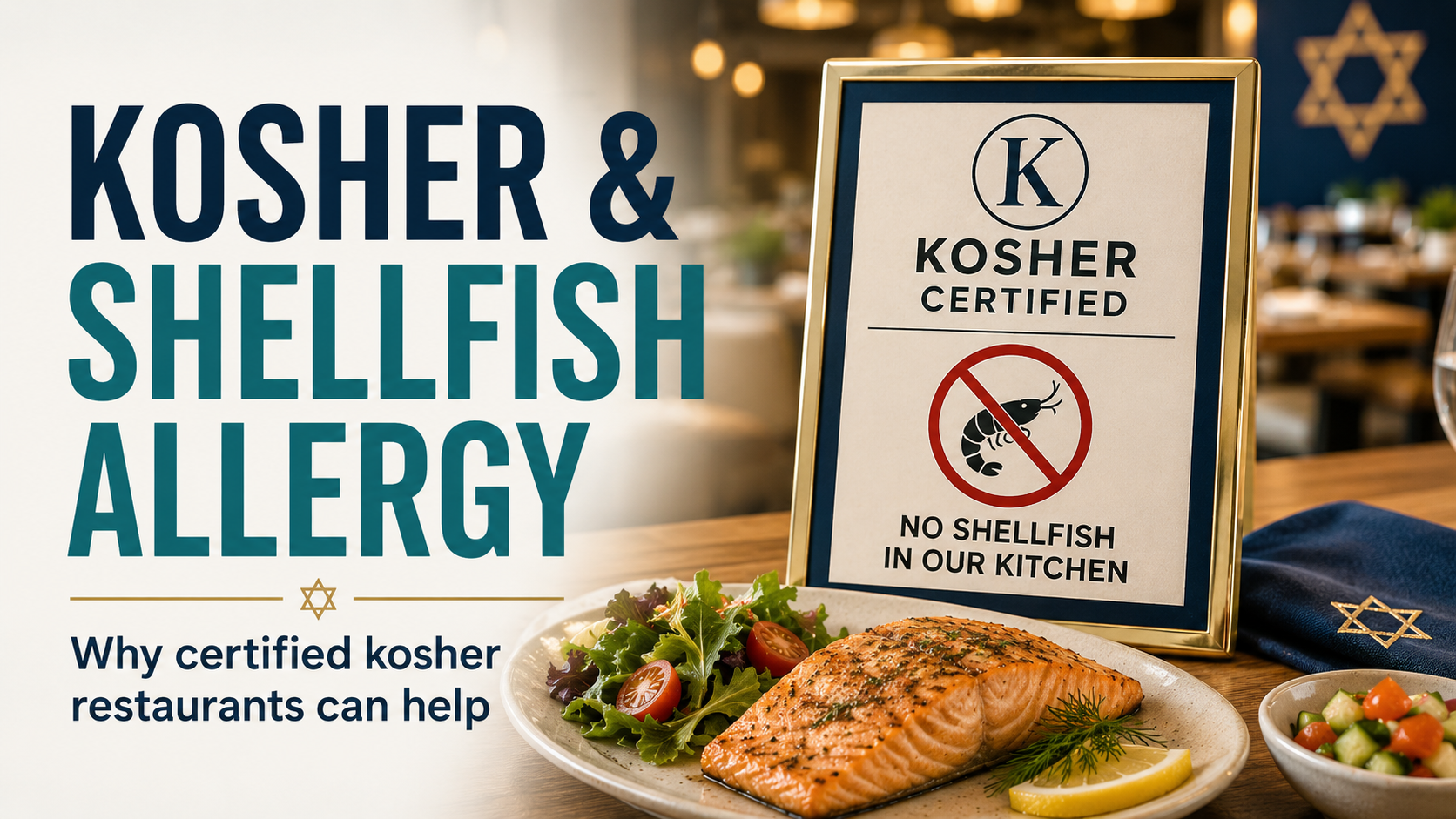
That is why certified kosher restaurants are worth understanding.
In a truly certified kosher restaurant, shellfish is not just absent from certain dishes. It is prohibited by the standard itself.
Shellfish cannot be served, cooked, stored, or handled as part of a certified kosher kitchen operation.
For shellfish avoidance, that makes kosher certification a much stronger signal than an ordinary menu claim.
Why Shellfish Allergy Is About the Whole Kitchen
Shellfish allergy is often treated as if it is only about avoiding obvious menu items.
But in restaurants, cross-contact can matter just as much as the listed ingredients.
Shellfish can create risk through shared prep surfaces, fryers, grills, utensils, serving dishes, sauces, stocks, steam, or accidental ingredient transfer.
FARE advises people with shellfish allergy to steer clear of seafood restaurants because of the high risk of cross-contact. It also notes that shellfish protein may be present in steam when shellfish is being cooked.
Source: FARE, Shellfish Allergy
Food Allergy Canada similarly notes that people with crustacean or mollusc allergies can, on rare occasions, react without eating these foods, including through cooking vapours or dishes used to present shellfish.
Source: Food Allergy Canada, Crustaceans and Molluscs
That is why a shellfish-free dish and a shellfish-free kitchen are not the same thing.
A menu item can look safe while the broader kitchen still handles shellfish throughout the day.
Why Certified Kosher Restaurants Are Different
Kosher dietary law does not allow shellfish.
For seafood to be kosher, it must come from a fish with fins and scales. Shrimp, crab, lobster, clams, oysters, mussels, and scallops are not kosher.
OU Kosher explains that kosher fish must have fins and scales, and that all shellfish are prohibited.
Source: OU Kosher, Fish Q&A
This creates a practical difference that ordinary allergy language usually does not.
A restaurant can say it has shellfish-free options while still handling shellfish elsewhere in the kitchen.
A certified kosher restaurant cannot treat shellfish as part of its food operation and remain certified kosher.
That is the point.
The restaurant is not simply saying, “This dish does not contain shellfish.”
It is operating under an external standard where shellfish is not allowed in the certified kitchen.
Certification Is the Strongest Part of the Signal
The strength of kosher certification is not only the rule.
It is the accountability around the rule.
A restaurant with shellfish-free options is usually making an internal claim. That claim may be honest, but it depends on the restaurant’s own menu accuracy, staff communication, training, and kitchen discipline.
Certified kosher status is different.
The restaurant is maintaining a standard that exists outside its own marketing. If it violates that standard, it can lose the certification that allows it to present itself as certified kosher.
For shellfish specifically, this is unusually clear.
Shellfish is not a borderline kosher issue. It is prohibited.
That makes certified kosher status one of the strongest restaurant-level signals available for people trying to avoid shellfish.
Certified Means Certified, Not Kosher-Style
The word certified matters.
There is a major difference between a certified kosher restaurant and a place that is merely kosher-style, Jewish-style, kosher-friendly, or offering a few kosher packaged products.
A kosher-style deli may serve traditional Jewish foods without following kosher dietary law.
A restaurant may use kosher language without the full kitchen operating under kosher supervision.
For shellfish avoidance, the useful signal comes from actual kosher certification.
If the restaurant is only “kosher-style,” the shellfish assumption does not apply.
Kosher Does Not Mean Fish-Free
Certified kosher restaurants cannot serve shellfish, but they can serve kosher fish.
That means a kosher restaurant may still serve salmon, tuna, cod, trout, herring, or other fish that meet kosher requirements.
This article is about shellfish allergies, not fish allergies.
The FDA treats fish and crustacean shellfish as separate major food allergen categories. Someone with a shellfish allergy is not necessarily allergic to fish, and someone with a fish allergy is not necessarily allergic to shellfish.
Source: FDA, Food Allergies
Food Allergy Canada also explains that fish, crustaceans, and molluscs are often grouped together as “seafood,” but people allergic to one type of seafood may not be allergic to another.
Source: Food Allergy Canada, Fish Allergy and Seafood
So the distinction is simple:
Certified kosher is a strong signal for shellfish avoidance.
It is not a fish-free standard.
Final Thought
For people with shellfish allergies, restaurant risk is often about the whole kitchen, not just one menu item.
That is why certified kosher restaurants are a useful category to understand.
A regular restaurant may offer shellfish-free dishes while still handling shellfish elsewhere.
A certified kosher restaurant is different because shellfish is excluded by the certification standard itself. The restaurant is not just making an internal menu claim; it is operating under an external standard it must maintain to keep its certification.
That does not make kosher certification the same as allergy certification.
But for shellfish specifically, it offers something most ordinary restaurant claims do not: external accountability around whether shellfish can be part of the kitchen at all.
Sometimes the most useful information is not whether a dish sounds safe.
It is whether the restaurant’s operating standard excludes the ingredient entirely.
Read how shellfish stacks up against the prevalence of other food allergies to understand the scale of shellfish allergy in the United States.
Explore what the shellfish allergy category is hiding to understand the difference between crustacean and mollusk allergies.
Visit our allergy and food restriction guide hub for more guides, or read how Simpa handles restaurant and community data.