
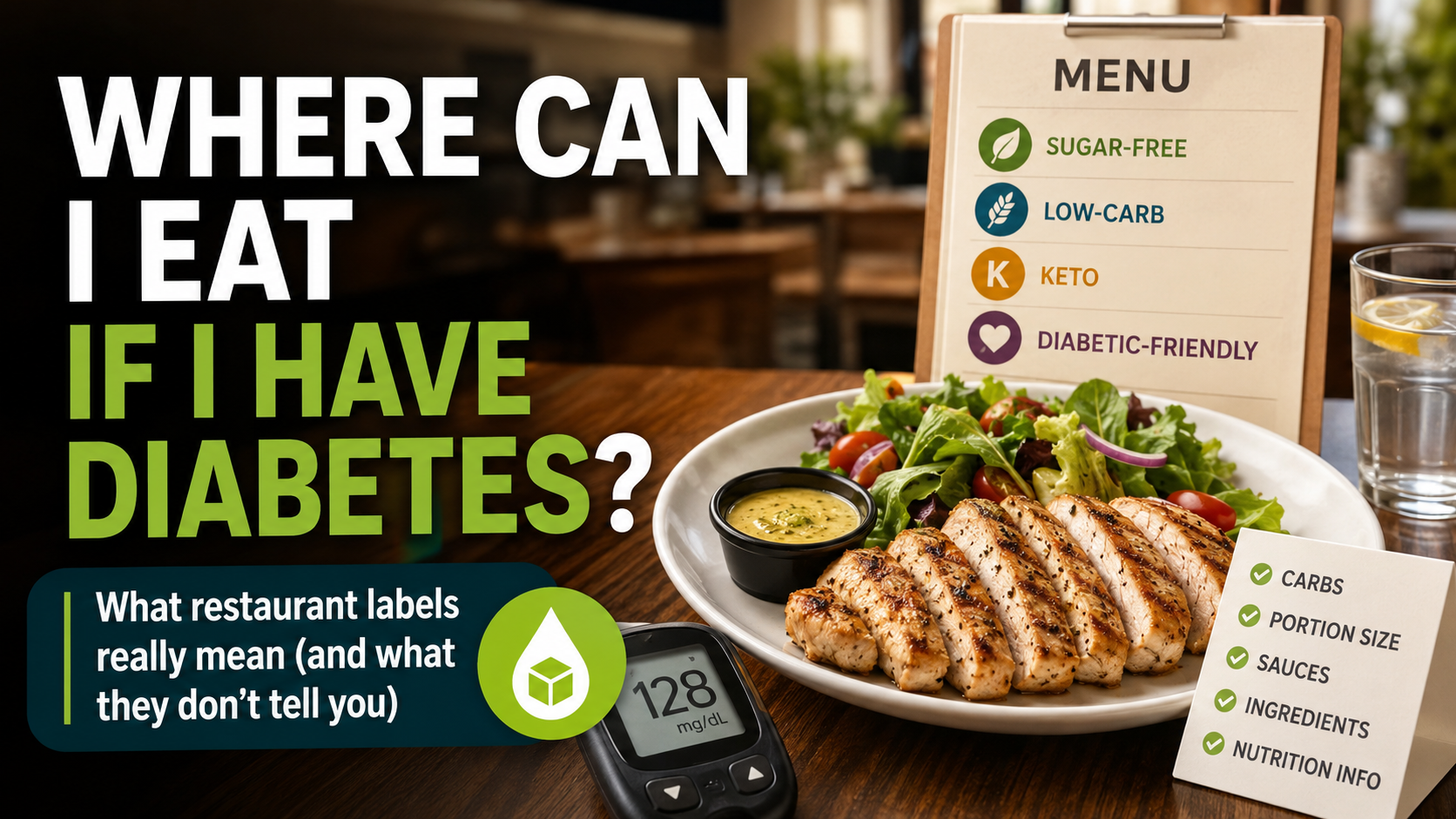
A restaurant marks a dessert as sugar-free.
Another places a keto symbol beside a burger bowl.
A third describes its grilled chicken and vegetables as diabetic-friendly.
To someone scanning a menu, the labels appear to solve the same problem.
Choose less sugar. Avoid the obvious desserts. Look for the option designed for people with diabetes.
But the labels can point to completely different meals.
The sugar-free dessert may still contain flour, starch, milk, fruit, or sugar alcohols.
The keto burger bowl may contain almost no carbohydrates but provide little information about its portion, sauces, sodium, or fat.
The grilled chicken may have no special nutritional standard behind it at all. The restaurant may simply consider it healthier than the fried option.
Sugar receives most of the attention because it is easy to see.
Restaurant meals are rarely that simple.
So what else do diners need to watch for when eating with diabetes?
Why Sugar Became the Headline
Sugar is easy to identify and easy to market.
It appears in desserts, candy, soft drinks, syrups, sweetened coffee, glazes, and sauces. A restaurant can remove it, replace it, or advertise that it was never added.
Other carbohydrates are less visible.
They appear in bread, rice, noodles, potatoes, tortillas, flour, batter, beans, fruit, milk, sauces, and drinks. Several may be combined in the same meal without making the dish taste particularly sweet.
Portion size adds another layer.
A scoop of rice and a restaurant-sized rice bowl contain the same ingredient, but they do not contain the same amount of carbohydrate.
Sugar became the shortcut because it is visible.
The less visible parts of the meal are where the label begins to lose meaning.
Carbohydrates Do Not Have to Taste Sweet
The American Diabetes Association divides carbohydrates into sugars, starches, and fibre.
| Type | Common restaurant sources | Why it matters |
|---|---|---|
| Sugars | Desserts, syrups, soft drinks, sweet sauces, fruit, milk | Includes naturally occurring and added sugars |
| Starches | Bread, rice, pasta, noodles, potatoes, tortillas, flour, batter | Can provide substantial carbohydrate without tasting sweet |
| Fibre | Vegetables, beans, lentils, fruit, whole grains | Appears within total carbohydrate but is processed differently from many other carbohydrates |
Consider two meals.
The first is grilled chicken coated in a sweet glaze and served with vegetables.
The second is unsweetened grilled chicken served with white rice and flatbread.
The added sugar is obvious in the first meal.
The second may contain almost none, but the rice and bread still contribute carbohydrates.
Looking only at sugar would identify the visible issue in the first meal while overlooking most of the second.
For people who count carbohydrates, the American Diabetes Association recommends looking at total carbohydrate. That number includes sugar, starch, and fibre.
A restaurant meal can also combine several carbohydrate sources at once:
| Dish | Carbohydrates that may be easy to overlook |
|---|---|
| Fried chicken sandwich | Bun, flour, breadcrumbs, sauce, fries |
| Stir-fry | Rice, noodles, cornstarch, sweetened sauce |
| Salad | Croutons, beans, grains, fruit, dressing |
| Soup | Noodles, potatoes, beans, flour, cornstarch |
| Breakfast plate | Toast, pancakes, potatoes, juice, sweetened coffee |
| Grilled entrée | Marinade, glaze, sauce, rice, bread |
| Sugar-free dessert | Flour, crust, milk, fruit, sugar alcohols |
None of these ingredients is automatically unsuitable.
The issue is that their combined amount may be difficult to see from the name of the dish.
A grilled skewer with vegetables and rice on the side exposes the structure of the meal.
A battered entrée covered in sauce and served over noodles hides more of it inside the preparation.
What Are Sugar Alternatives Actually For?
Removing table sugar changes one ingredient.
The result depends on what replaces it.
Some alternatives reduce both sugar and calories. Some provide texture and bulk with a smaller blood glucose effect than ordinary sugar. Some are metabolized differently. Others remain conventional sources of sugar despite sounding more natural.
| Sweetener group | Examples | Main reason it is used | What diners should understand |
|---|---|---|---|
| High-intensity and non-nutritive sweeteners | Stevia, sucralose, aspartame, saccharin, acesulfame potassium, monk fruit | To provide sweetness with little or no sugar and usually few calories | They generally have little direct effect on blood glucose, but the rest of the dish may still contain substantial carbohydrate |
| Sugar alcohols | Erythritol, xylitol, sorbitol, maltitol, mannitol, isomalt | To reduce sugar while preserving sweetness, bulk, or texture | They usually produce a smaller glucose change than sugar, but absorption and digestive effects vary |
| Differently metabolized sugars | Allulose, tagatose, isomaltulose | To provide sugar-like taste or texture with different metabolic properties | They are not interchangeable and should be evaluated individually |
| Traditional caloric sweeteners | Honey, maple syrup, agave, date syrup, coconut sugar, brown sugar | For sweetness, flavour, texture, or natural positioning | They still provide sugar, carbohydrate, and calories |
High-intensity sweeteners are often relevant to both diabetes management and calorie reduction. The two purposes overlap.
Stevia or sucralose can replace added sugar without producing the same direct glucose effect as table sugar. Because only small quantities are needed, they can also reduce calories.
That does not make the complete food low in carbohydrates.
A cheesecake made with sucralose may still contain flour, milk, fruit, or a carbohydrate-heavy crust. A muffin sweetened with stevia may still be built mainly from starch.
Sugar alcohols create a different situation.
The FDA explains that they are slowly and incompletely absorbed. They generally provide fewer calories than sugar and produce a smaller change in blood glucose than many other carbohydrates.
The size of that effect varies.
Erythritol is not metabolized in the same way as maltitol. Maltitol is not identical to sorbitol or xylitol. Some sugar alcohols can still affect blood glucose, and larger quantities may cause gas, bloating, or diarrhea.
Allulose belongs in another group. It is technically a sugar, but the body handles it differently from table sugar. Current FDA guidance allows it to be excluded from the Total Sugars and Added Sugars lines on US Nutrition Facts labels and assigns it a lower calorie value.
Honey, maple syrup, agave, and date syrup do not belong in any of those groups.
They may differ in flavour, source, and processing, but they still contribute sugars and carbohydrates. Replacing white sugar with honey does not make a dessert sugar-free. Using agave does not make a drink carbohydrate-free.
The word alternative tells the diner that something was substituted.
It does not explain what nutritional problem the substitution solved.
What Do the Menu Labels Actually Mean?
Sugar-free, no added sugar, low-carb, keto, and diabetic-friendly are often displayed as though they are variations of the same claim.
They are not.
| Label | What it usually means | What it does not reveal |
|---|---|---|
| Sugar-free | On regulated US packaged foods, less than 0.5 grams of sugar per labelled serving | Total carbohydrate, starch, calories, sweetener used, or portion size |
| No added sugar | Sugar was not added during production or preparation | Naturally occurring sugar, starch, or total carbohydrate |
| Low-carb | The food contains less carbohydrate than a reference product, meal, or unstated comparison | The exact amount or whether it fits the diner’s plan |
| Keto | The item is intended for a very-low-carbohydrate eating pattern | Portion size, sodium, fat, ingredient quality, or suitability for every person with diabetes |
| Diabetic-friendly | The restaurant believes the item may fit diabetes-related needs | The standard, threshold, or evidence behind the claim |
A sugar-free cookie can still contain flour.
A no-added-sugar smoothie can still contain carbohydrates from fruit and milk.
A low-carb meal may be lower than the restaurant’s standard version without being particularly low in absolute terms.
A keto dish can provide useful information about carbohydrate restriction, but people with diabetes do not all follow ketogenic diets or avoid carbohydrates entirely.
The ADA recognizes several eating patterns for diabetes management, including low-carbohydrate and very-low-carbohydrate approaches. It also emphasizes that carbohydrates do not need to be eliminated completely. Some people count them and match them to insulin. Others focus on consistency, portions, fibre, or the types of carbohydrate they choose. (diabetes.org)
The labels answer different questions.
Treating them as synonyms makes all of them less useful.
Portion and Preparation Can Change the Meal
The same ingredient can become several different restaurant meals.
Chicken can be grilled, breaded, battered, glazed, placed inside a bun, served over rice, or covered in a thickened sauce.
Vegetables can be steamed, roasted, fried, candied, or coated in sauce.
Coffee can be served black or turned into a large drink containing milk, syrup, whipped cream, and toppings.
| Menu wording | What it may signal |
|---|---|
| Grilled, baked, steamed, or broiled | Fewer hidden coatings, although sauces and portions still matter |
| Breaded, battered, crispy, or crunchy | Flour, breadcrumbs, or starch |
| Glazed, sticky, honey, barbecue, or teriyaki | Added sugar or sweetened sauce |
| Creamy | Added fat and possibly flour or starch |
| Loaded, deluxe, or fully dressed | A larger portion with several combined toppings |
| Sauce on the side | More control over how much sauce is used |
Serving size can change the impact just as much as the recipe.
A restaurant may publish nutrition information for one portion while serving a dish that diners commonly share, divide, or eat alongside bread, appetizers, and drinks.
Protein, fat, and fibre can also affect digestion and fullness, but they do not erase the carbohydrates in the meal.
The restaurant plate must be read as a whole.
Some Restaurant Formats Make the Meal Easier to See
No cuisine is inherently suitable or unsuitable for people with diabetes.
The more useful question is whether the menu makes proteins, starches, vegetables, sauces, and portions visible.
| Restaurant format | What may make it easier to navigate | What can still complicate the meal |
|---|---|---|
| Grills and steakhouses | Proteins and sides are usually listed separately | Potatoes, bread, sauces, and oversized portions |
| Mediterranean and Middle Eastern | Grilled proteins, salads, vegetables, rice, and bread are often visible | Pita, rice, hummus, beans, sauces, and desserts |
| Japanese | Fish, tofu, vegetables, and rice may be ordered separately | Sushi rice, tempura, noodles, and sweetened sauces |
| Mexican | Bowls and substitutions can make portions adjustable | Tortillas, rice, beans, chips, and sauces |
| South Asian | Grilled dishes, curries, lentils, rice, and breads can often be selected separately | Rice, naan, potatoes, fried foods, and sweet drinks |
| Chinese and Southeast Asian | Proteins and vegetables are widely available | Rice, noodles, batter, cornstarch, and sweet sauces |
| Italian | Ingredients and dishes are familiar | Pasta, pizza, bread, breading, and large servings |
| Fast food | Nutrition information is often published | Buns, fries, batter, sauces, and sweetened drinks |
| Bakeries and cafés | Sugar-free products may be clearly marked | Flour, crusts, milk, starch, and serving size |
This is not a ranking of good and bad cuisines.
A Mediterranean meal can combine rice, pita, hummus, sauce, and dessert. A fast-food restaurant may publish precise carbohydrate information and offer easy substitutions.
Visibility is the practical advantage.
It is easier to understand a plate when its major components remain separate.
Why Diabetic-Friendly Is a Problematic Label
The CDC estimates that 40.1 million people in the United States had diagnosed or undiagnosed diabetes in 2023.
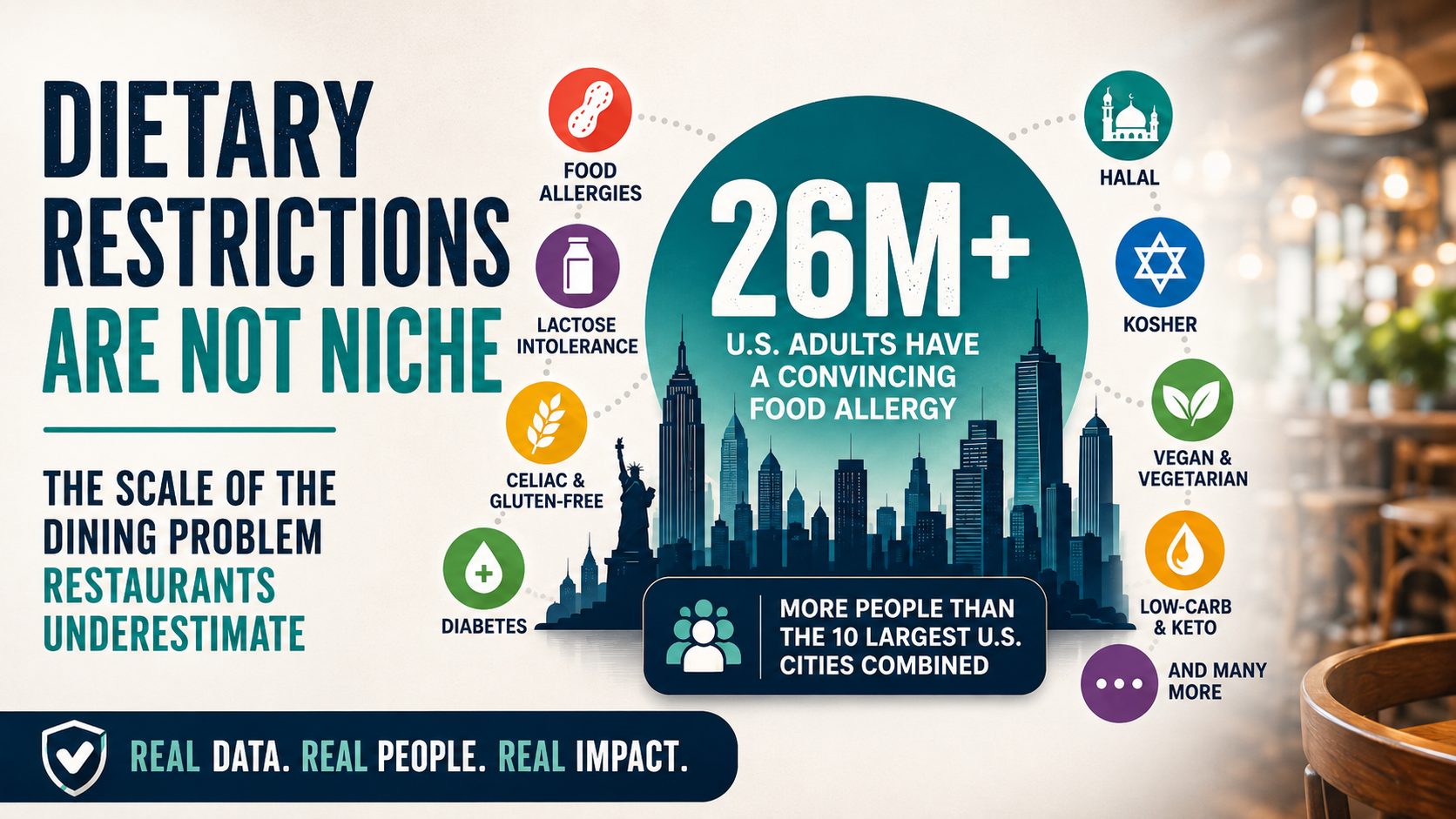
As discussed in our article about the scale of dietary restrictions, this is not a niche dining need.
Yet diabetic-friendly is one of the least precise labels used by restaurants.
Unlike sugar-free, it does not have one fixed FDA threshold.
A restaurant may use it to describe a dish with no added sugar, fewer carbohydrates, a smaller portion, more fibre, grilled protein, or simply what it considers a healthier choice.
Each of those claims could be useful.
Combining them under one unexplained label is not.
Diabetic-friendly presents the conclusion without showing how the restaurant reached it.
That does not make the label worthless.
It can help diners discover restaurants that have considered diabetes-related needs. It may point toward nutrition data, substitutions, flexible portions, lower-carbohydrate options, or no-added-sugar dishes.
But a discovery label cannot replace the information needed to choose a meal.
How Simpa Can Make the Label More Useful
Simpa includes diabetic-friendly as a restaurant-level option because people actively search for restaurants that may support their needs.
The label can narrow the search.
It cannot describe every item in the restaurant.
A restaurant may offer grilled proteins, adjustable sides, nutrition data, and lower-carbohydrate meals while also serving sweetened drinks, large desserts, and starch-heavy entrées.
That is where menu-level information becomes more useful.
Simpa is uploading menus from selected restaurant chains. As that coverage grows, individual items can be described using information that is more precise than one restaurant-wide category.
| Restaurant-level information | Menu-level information |
|---|---|
| The restaurant identifies itself as diabetic-friendly | The item’s total carbohydrate is published |
| Lower-carbohydrate choices are available | The main starches are identified |
| Substitutions may be possible | The starch portion can be changed |
| Nutrition information is available | The serving size and nutrition data are connected |
| Sugar-free items are offered | The sweetener used is identified |
| Customizable meals are available | Sauces, sides, and toppings can be evaluated separately |
Simpa does not decide what a person with diabetes should eat.
Our role is to make the restaurant’s own information easier to find and understand.
A broad label helps someone discover a possible restaurant.
Menu details explain what the food actually contains.
Final Thought
Restaurant labels can be accurate without being complete.
Sugar-free describes sugar.
Low-carb describes a comparison.
Keto describes a very-low-carbohydrate eating pattern.
Diabetic-friendly may describe almost anything the restaurant believes will help.
The diner still needs to understand the meal behind the label.
That means looking beyond sweetness to the carbohydrates, portion, preparation, sauce, starches, drinks, and sweetener used.
Sugar may be the first thing people notice.
It is not the only thing on the plate.
Read why dietary restrictions are not a niche concern.
Learn why restaurant menus need to provide more than broad labels.
Explore our allergy and food restriction guide hub, or read how Simpa handles restaurant and community data.
Sources and Notes
- National Diabetes Statistics Report, US Centers for Disease Control and Prevention
- Healthy Eating With Diabetes, US Centers for Disease Control and Prevention
- Types of Carbohydrates, American Diabetes Association
- Reading Food Labels, American Diabetes Association
- Get to Know Carbs, American Diabetes Association
- Eating for Diabetes Management, American Diabetes Association
- Dining Out, Diabetes Canada
- Basic Meal Planning, Diabetes Canada
- Sugar Alcohols, US Food and Drug Administration
- Aspartame and Other Sweeteners in Food, US Food and Drug Administration
- FDA Guidance on Allulose
- FDA Guidance on Sugar-Free Claims
This article explains restaurant labels and food information. Individual needs may differ according to diabetes type, medication, insulin use, and a person’s treatment plan.