
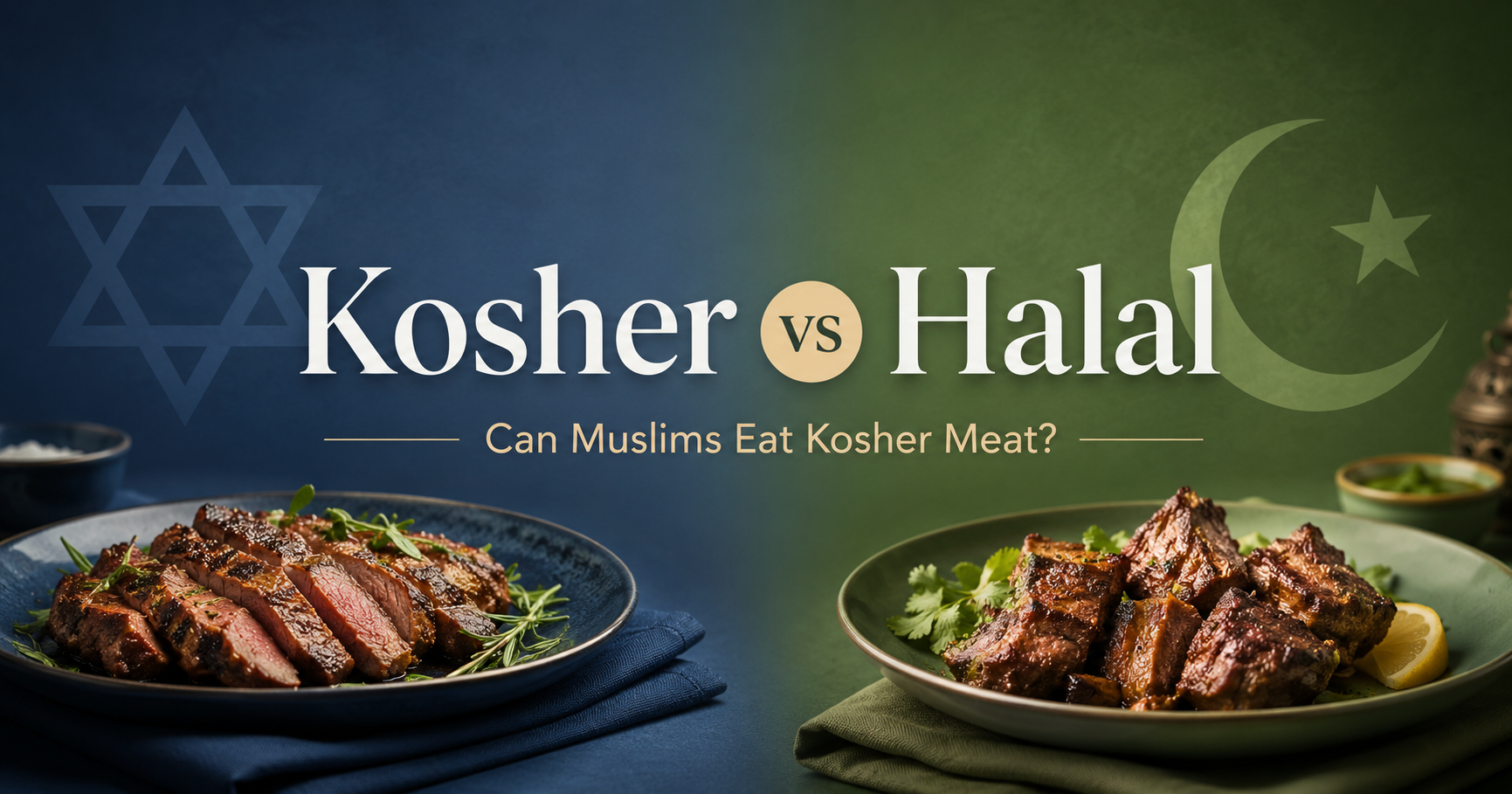
Kosher meat can look like an obvious alternative to halal meat.
Both traditions prohibit pork. Both regulate which animals may be eaten. Both treat slaughter as a religious act rather than an ordinary step in food production.
That overlap is real, but it does not produce one answer for every Muslim.
Some Sunni authorities permit kosher meat under the Quranic rules concerning the People of the Book. Other Muslim authorities apply additional conditions. Under the published Twelver Shia rulings of Ayatollah Ali al-Sistani, the slaughterer must be Muslim, so ordinary kosher meat would not qualify.
Even when the meat itself is accepted, the finished dish may contain wine, beer, liqueur, or another ingredient the diner avoids.
The label on the restaurant is only the beginning of the answer.
Where Kosher and Halal Overlap
Jewish dietary law and Islamic dietary law are separate systems, but their rules intersect in several important places.
Neither permits pork. Both restrict the animals that can be eaten. Both require blood to be removed from meat, and both have religious rules governing slaughter.
Kosher slaughter is called shechita. It is performed by a trained Jewish slaughterer called a shochet. The shochet uses a carefully inspected, sharp knife to make the required cut. The animal is then examined for defects that could make it nonkosher.
Chabad explains that a shochet must study the laws of shechita and train in the preparation and use of the slaughtering knife. The Orthodox Union also explains that kosher meat requires special slaughter, inspection, and processing.
These similarities are why the question arises at all. Kosher meat is not ordinary unsupervised meat. It comes from a defined religious process with meaningful points of contact with halal slaughter.
The remaining differences determine whether a particular Muslim considers it acceptable.
Can Sunni Muslims Eat Kosher Meat?
A significant Sunni basis for permitting kosher meat comes from Quran 5:5, which declares the food of the People of the Book lawful for Muslims. Jews are included among the People of the Book.
Egypt’s Dar al-Ifta applies that principle directly to kosher meat. Its ruling treats meat slaughtered by Jews and Christians as permissible unless the Muslim knows that the animal was not properly slaughtered or that the person who performed the slaughter was not from the People of the Book.
A Sunni Muslim following that ruling may eat genuine kosher meat without requiring a separate halal certificate.
Sunni rulings are not completely uniform, however. Some scholars pay closer attention to the invocation made during slaughter and whether it applies to every animal. That question can make the type of meat important.
There is no reliable global percentage showing how many Sunni Muslims personally eat kosher meat. Population figures for Sunni and Shia Muslims cannot be converted into acceptance rates because people within each tradition follow different scholars and standards.
Can Shia Muslims Eat Kosher Meat?
The answer depends on which Shia legal authority the diner follows.
Under the published Twelver Shia rulings of Ayatollah Ali al-Sistani, the person performing the slaughter must be Muslim. His ruling also requires the slaughterer to mention the name of Allah in connection with the act.
Ordinary kosher meat is slaughtered by a Jewish shochet. A Twelver Shia Muslim following Sistani’s ruling would therefore not consider that meat halal, even though it was properly slaughtered under Jewish law.
This is an authority specific ruling, not proof that every Shia Muslim follows the same scholar or makes the same personal choice. The useful question is not simply whether someone is Shia. It is which legal authority and slaughter standard that person follows.
Why Kosher Beef and Kosher Chicken May Get Different Answers
One of the most detailed Muslim discussions of kosher slaughter concerns tasmiyah, the mention of God’s name at the time of slaughter.
A shochet normally recites a blessing before slaughtering. The blessing may cover a continuous series of animals rather than being repeated before every individual animal.
In his comparative paper Is Kosher Halal?, presented at an Assembly of Muslim Jurists of America conference, Yasir Qadhi argues that this practice can produce different answers for beef and chicken.
Larger animals take more time to process. According to his analysis, a separate blessing is normally made for each animal in kosher beef production. He therefore considers kosher beef halal under the Sunni requirements examined in the paper.
Chicken can be different. A shochet may slaughter many birds after one blessing. A Muslim who requires a separate tasmiyah for every animal may not accept that chicken. A Muslim who accepts one invocation for a continuous group may consider it halal.
This is Qadhi’s analysis, not a universal ruling for every Sunni Muslim. It shows why the broad phrase kosher meat can hide a detail that matters.
For a Muslim following Sistani’s Twelver Shia ruling, the beef and chicken distinction does not solve the central issue. The slaughterer was still not Muslim.
The Meat May Be Acceptable, but the Dish May Not Be
Kosher law does not prohibit alcohol as a category.
Kosher wine, beer, brandy, and liqueur can all exist when their ingredients and production meet Jewish dietary rules. The Orthodox Union certifies alcoholic beverages and publishes guidance on kosher wine.
Islamic law prohibits intoxicants. Quran 5:90 instructs Muslims to avoid them.
A dish can therefore be completely kosher while containing red wine sauce, beer batter, a wine based marinade, brandy in a glaze, or liqueur in a dessert.
For a Muslim who accepts the kosher meat, the practical question is:
Is wine, beer, liqueur, or another alcoholic drink intentionally used anywhere in this dish?
The answer should cover the marinade, stock, sauce, glaze, cooking liquid, and dessert.
Restaurants should describe the actual ingredient rather than saying only that something contains “alcohol.” Wine added to a sauce is not the same factual situation as vinegar, an extract, or a trace processing ingredient. Different Muslim authorities may evaluate those cases differently.
Clear ingredients are more useful than vague reassurance.
What Kosher Certification Does and Does Not Tell You
A reliable kosher certification provides valuable information.
It can confirm that pork is excluded, that meat sold as kosher underwent kosher slaughter, and that ingredients, equipment, and preparation are supervised according to the certifier’s Jewish standard.
It does not confirm that the slaughterer was Muslim. It does not prove that tasmiyah met every Islamic requirement. It does not guarantee that the recipe contains no wine or other alcoholic ingredient.
Kosher certification answers a Jewish dietary question. A Muslim diner can use that information, but the kosher symbol is not a universal halal symbol.
Kosher Style Is Not Kosher
A restaurant described as kosher style may serve traditional Jewish dishes without following kosher law.
As Chabad notes, a kosher style restaurant may serve foods such as chicken soup and matzah balls even when the food itself is not kosher.
Such a restaurant may use meat that was not ritually slaughtered, combine meat and dairy, use ordinary kitchen equipment, or operate without religious supervision.
A Muslim considering kosher meat should ask whether the restaurant or product is actually certified kosher and which organization provides that certification.
Why Halal Meat Is Not Automatically Kosher
The relationship does not work equally in both directions.
Some Muslim authorities accept kosher meat because Islamic law contains a specific permission concerning the food of the People of the Book.
Jewish law still requires meat to satisfy Jewish slaughter, inspection, processing, and supervision rules. Halal meat does not become kosher simply because it came from a permitted animal and was slaughtered according to Islamic law.
A Jewish diner who keeps kosher needs meat that independently meets kosher requirements.
The two systems overlap, but they are not interchangeable.
What Should a Muslim Ask at a Kosher Restaurant?
A restaurant does not need to interpret Islamic law. It needs to provide accurate facts.
The diner should ask whether the restaurant is certified kosher, which organization provides the certification, what type of meat is being served, and whether wine, beer, liqueur, or another alcoholic beverage appears anywhere in the recipe.
The restaurant should check the recipe or ingredient label instead of guessing.
With those facts, the diner can apply the Sunni or Shia ruling they follow.
Final Answer
Can Muslims eat kosher meat?
Many Sunni authorities permit meat slaughtered by Jews under Quran 5:5, although some Sunni rulings raise additional questions about tasmiyah, especially with chicken.
Under Ayatollah Sistani’s Twelver Shia ruling, ordinary kosher meat is not halal because the slaughterer must be Muslim.
For Muslims who accept the meat, the finished dish must still be checked. Kosher food can contain wine, beer, brandy, or liqueur.
The answer depends on the diner’s religious authority, the slaughter process, the type of meat, and the complete recipe.
Sources and Notes
- Quran 5:5 on the food of the People of the Book
- Quran 5:90 on intoxicants
- Egypt’s Dar al-Ifta on eating kosher food
- Ayatollah Sistani’s conditions for slaughtering an animal
- Yasir Qadhi’s comparative paper on kosher and halal slaughter
- Chabad on the role of a shochet
- Orthodox Union kosher primer
- Chabad on kosher style food
Religious rulings vary among scholars, schools, communities, and individuals. This article summarizes published positions and practical dining considerations. It does not issue a personal religious ruling.